 Quanzhou Ausenist Technology Co., Ltd
 How System Integrators Should Verify a Special-Voltage Pump VFD Quotation
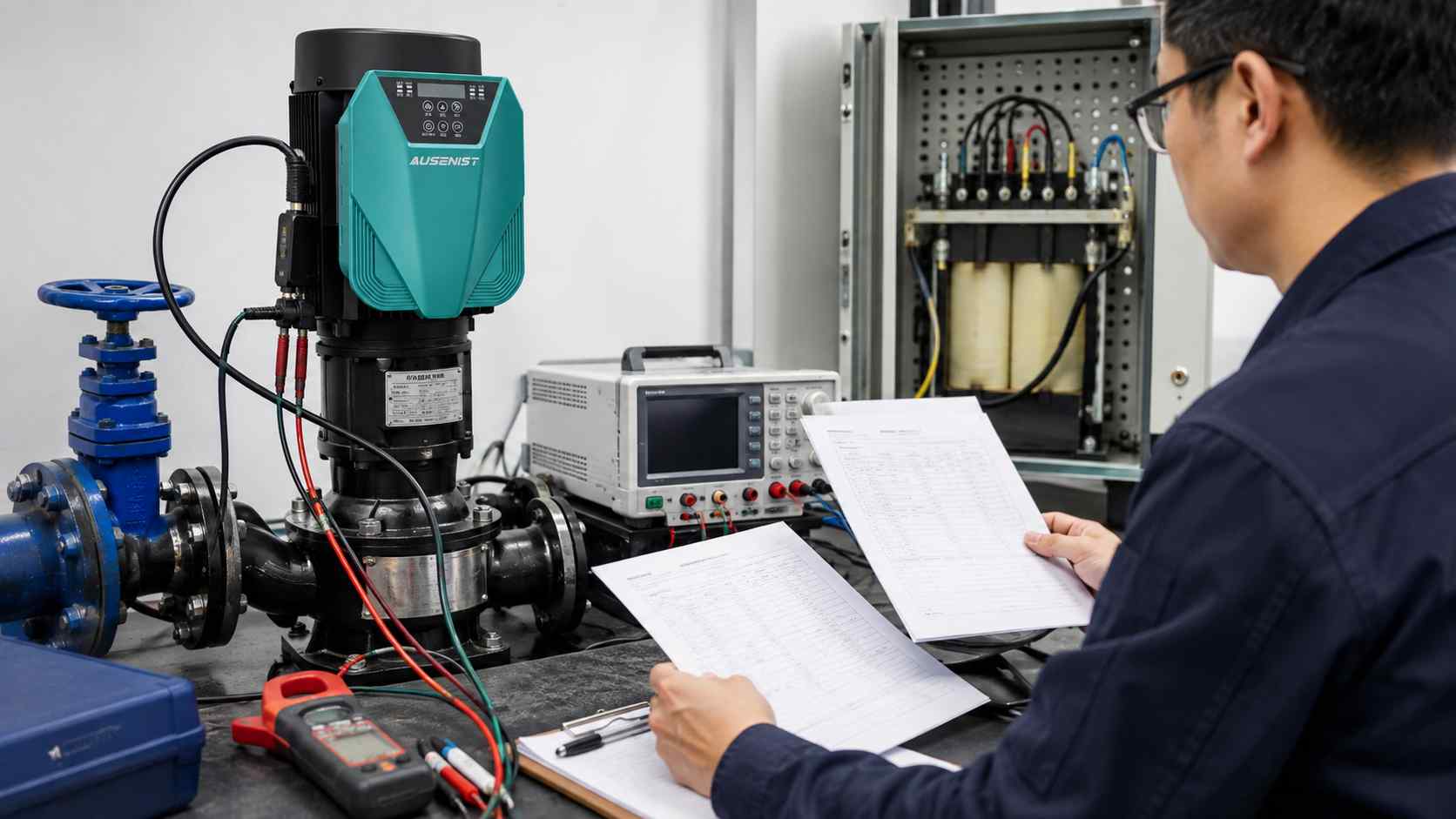
To verify a special-voltage pump VFD quotation, separate five items: input voltage, input phase, output voltage, output current and motor winding connection. A quotation that says only “220 V to 380 V” is incomplete because it does not prove that the proposed hardware, current rating and motor are compatible.
Special-voltage requirements must be confirmed from the exact ordered configuration. They should never be inferred from a standard model name or from kW alone.
What Information Is Required?
- Actual site supply voltage, phase, frequency and tolerance.
- Motor nameplate photograph and permitted star/delta connection.
- Motor rated current, power, frequency, speed and motor type.
- Pump duty, starting requirements and continuous operating range.
- Required input/output isolation, protection and enclosure arrangement.
- Quantity, destination market, mandatory documents and test expectations.
- Generator, transformer or weak-grid information when applicable.
Selection Example
A site has nominal 220 V single-phase power and a pump motor marked 380 V, 50 Hz, 7.5 kW. Before accepting a quotation, the integrator asks the supplier to identify the exact input and output ratings, continuous output current, motor compatibility and any supply-current or protection implications.
If the supplier cannot document that configuration for the required motor and site, the quotation should not be approved. The correct alternative may involve a different motor connection, another motor, a different supply arrangement or a separately engineered voltage-conversion solution.
Common Mistakes
- Treating “220 V” as complete without stating phase and frequency.
- Assuming every VFD can raise voltage to a 380 V output.
- Ignoring the much higher input current on a single-phase supply.
- Reconnecting motor windings without manufacturer confirmation.
- Accepting a custom-voltage claim without an exact ordering code and test scope.
AUSENIST Solution
AUSENIST can review the supply data and motor nameplate, then confirm whether a YS620, YS820 or separately reviewed configuration is appropriate. A quotation basis can distinguish standard capability, special requirements, current selection, external protection and items requiring validation.
Not every special-voltage request is practical or suitable. AUSENIST should decline to finalize a model when the input supply, motor connection or required output rating cannot be verified. Installation and protection must be designed by qualified personnel under the approved documentation and local regulations.
Send us the motor nameplate, quantity, voltage, application and project requirements. We can prepare VFD selection and quotation.