 Quanzhou Ausenist Technology Co., Ltd
Four-Pump Automatic Rotation and Fault-Skip Control with VFDs
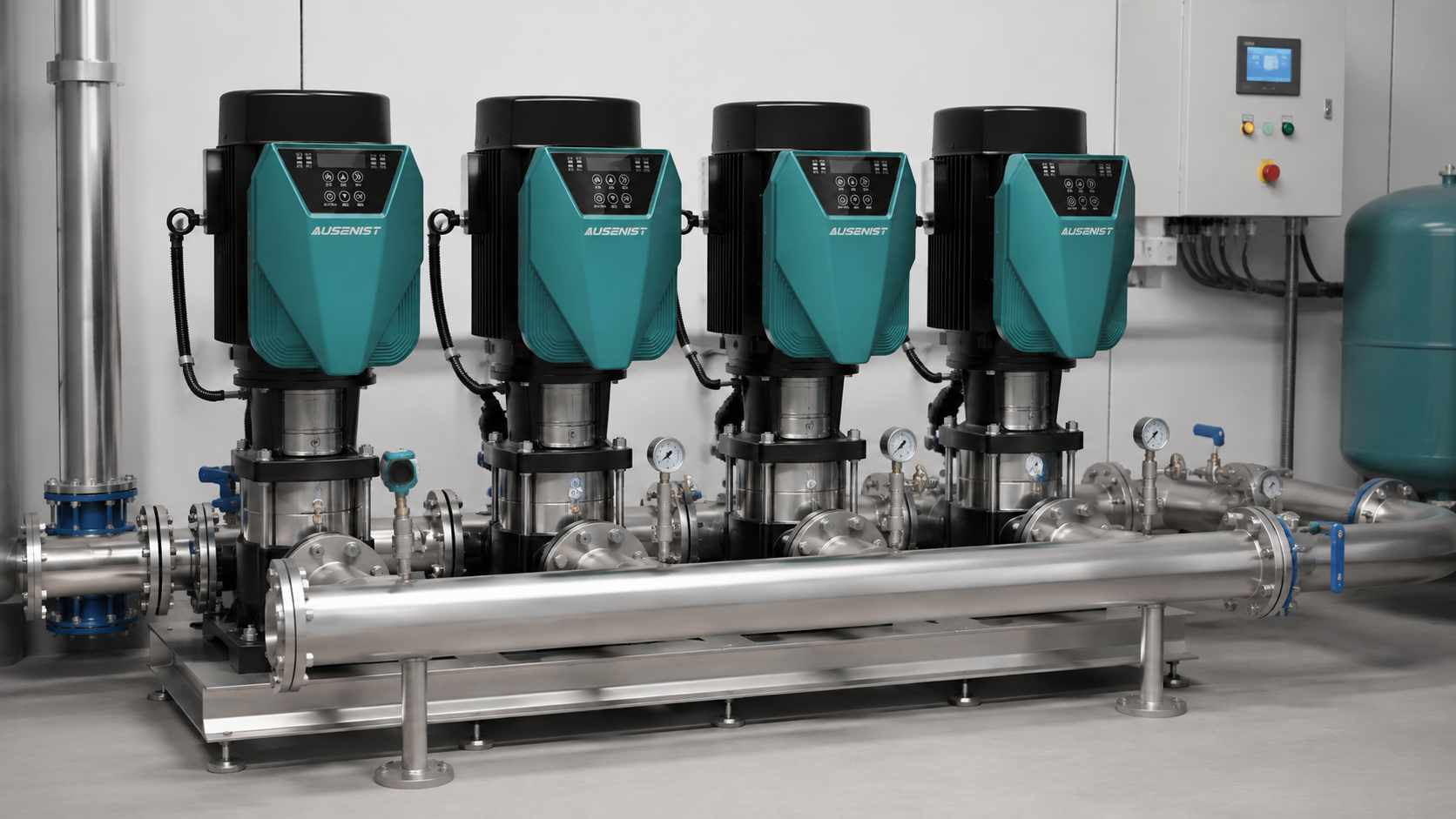
Engineering reference image; the operating result depends on the commissioned sequence.
Automatic rotation distributes running time across four pumps, while fault-skip logic prevents the controller from repeatedly calling a unit that is tripped, isolated or unavailable. The healthy pumps still need enough combined hydraulic capacity to meet the required duty.
Recommended Configuration
| Item | Reference Selection |
|---|---|
| Pumps | Four equal 5.5kW, 380V pumps |
| Drives | Four current-matched AUSENIST pump VFDs |
| Control | Shared pressure feedback and staged capacity |
| Rotation | By accumulated runtime or approved schedule |
| Availability | Ready, running, faulted, isolated and maintenance states |
| Recovery | Manual inspection or limited automatic reset as approved |
What Must Be Confirmed?
- Required N+1 capacity and peak-flow pump count.
- Rules that make a pump available or unavailable.
- Rotation interval and equalization tolerance.
- Fault types allowed to reset and maximum attempts.
- Alarm reporting and manual override requirements.
Selection Logic
Size each VFD for its motor. The controller must skip a failed address and call the next healthy pump without losing pressure control. Rotation occurs only among available units. Simulate every pump fault during acceptance testing and verify that the sequence does not enter a reset loop.
Common Mistakes
- Rotating only the lead role while assist pumps accumulate unequal hours.
- Automatically resetting short circuit, earth fault or repeated overload without investigation.
- Ignoring an isolation switch or maintenance state.
- Assuming three healthy pumps can meet the duty without checking curves.
AUSENIST Solution
AUSENIST can prepare multi-pump roles, addresses, runtime rotation, fault-skip parameters and a test sheet. Safety and process interlocks outside the drive must remain part of the project design.
FAQ
Does rotation guarantee equal hours?
It reduces imbalance, but demand and faults may prevent exact equality.
Should every fault trigger an automatic reset?
No. Only approved recoverable faults should have limited reset attempts.
Can one pump be manually removed from rotation?
Yes when the availability logic and local isolation are properly designed.
Related AUSENIST Pages
Send us all motor nameplates, pump curves, N+1 requirement and desired rotation rule. We can prepare the control configuration.