 Quanzhou Ausenist Technology Co., Ltd
 How Should Pump Distributors Choose a VFD Supplier?
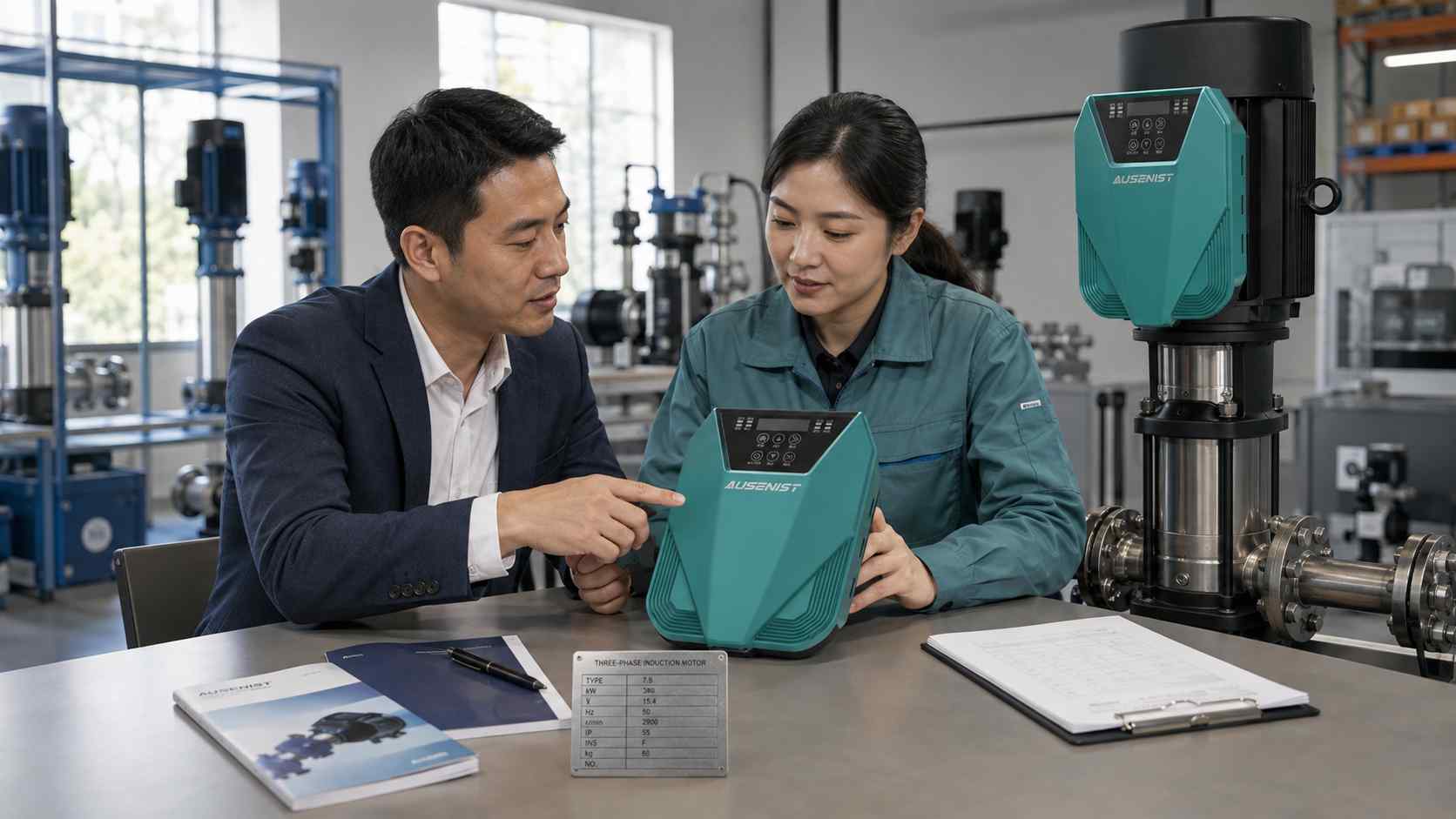
Pump distributors should choose a VFD supplier by checking application matching, order consistency, documentation, technical response and after-sales process—not by comparing unit price alone. A suitable supplier should be able to work from real motor and market data, explain selection limits, and reproduce the approved configuration in later batches.
The best commercial fit also depends on the distributor. A technically capable supplier may still be unsuitable if its voltage range, customization scope, order quantities, documentation or support method does not match the local business.
What Information Is Required?
Before asking for a quotation or distributor agreement, send:
- the motor nameplates or a table of rated power, voltage, current, frequency and motor type;
- the local input supply, including voltage, phase and frequency;
- the main pump applications, such as domestic boosting, irrigation, deep-well pumping or circulation;
- expected quantities by rating rather than one total annual estimate;
- required control functions, sensor type, communications, enclosure and installation method;
- packaging, language, private-label and technical-document needs;
- the distributor's commissioning and after-sales capability.
These details allow suppliers to quote the same scope. Without them, a low price may simply exclude functions, accessories or support included elsewhere.
Selection Example
Assume a distributor repeatedly receives requests for a 4 kW, 380/400 V centrifugal pump whose motor nameplate shows 8.5 A. One supplier selects only from the 4 kW label. Another checks the 8.5 A current, supply tolerance, pump duty, motor type, pressure-control method and installation environment before proposing a drive.
The second response is more useful because it exposes the engineering assumptions. The final VFD must be selected by its documented output-current capability and application conditions, not by kW alone. The distributor should then approve a sample configuration, ordering code, parameter record and document set before holding stock.
Common Mistakes
- Choosing the lowest quotation without making every supplier quote the same specification.
- Treating equal kW as proof that a VFD matches the motor current and duty.
- Assuming one voltage or phase configuration can serve every local pump installation.
- Accepting private labeling before the product, parameters and documents are approved.
- Failing to define who handles installation questions, fault evidence and warranty escalation.
AUSENIST Solution
AUSENIST can review a distributor's pump range, local supply and application mix, then recommend candidate YS620 or YS820 configurations for engineering confirmation. The scope can include model matching, basic parameter planning, sensor and control requirements, documentation, branding and a repeatable order specification.
Requirements involving special voltage conversion, motor compatibility, enclosure protection, communications, certification or unusual environments must be confirmed for the exact project before ordering. If motor data or the intended pump application is unavailable, AUSENIST should not finalize a selection by guesswork. Distributors planning inventory can also use the related guide on which water pump VFD models to keep in stock.
Tell us your main pump power range and local voltage. We can recommend a starter stock list and distributor pricing.