 Quanzhou Ausenist Technology Co., Ltd
 220V Single Phase to 380V Three Phase VFD for Water Pump
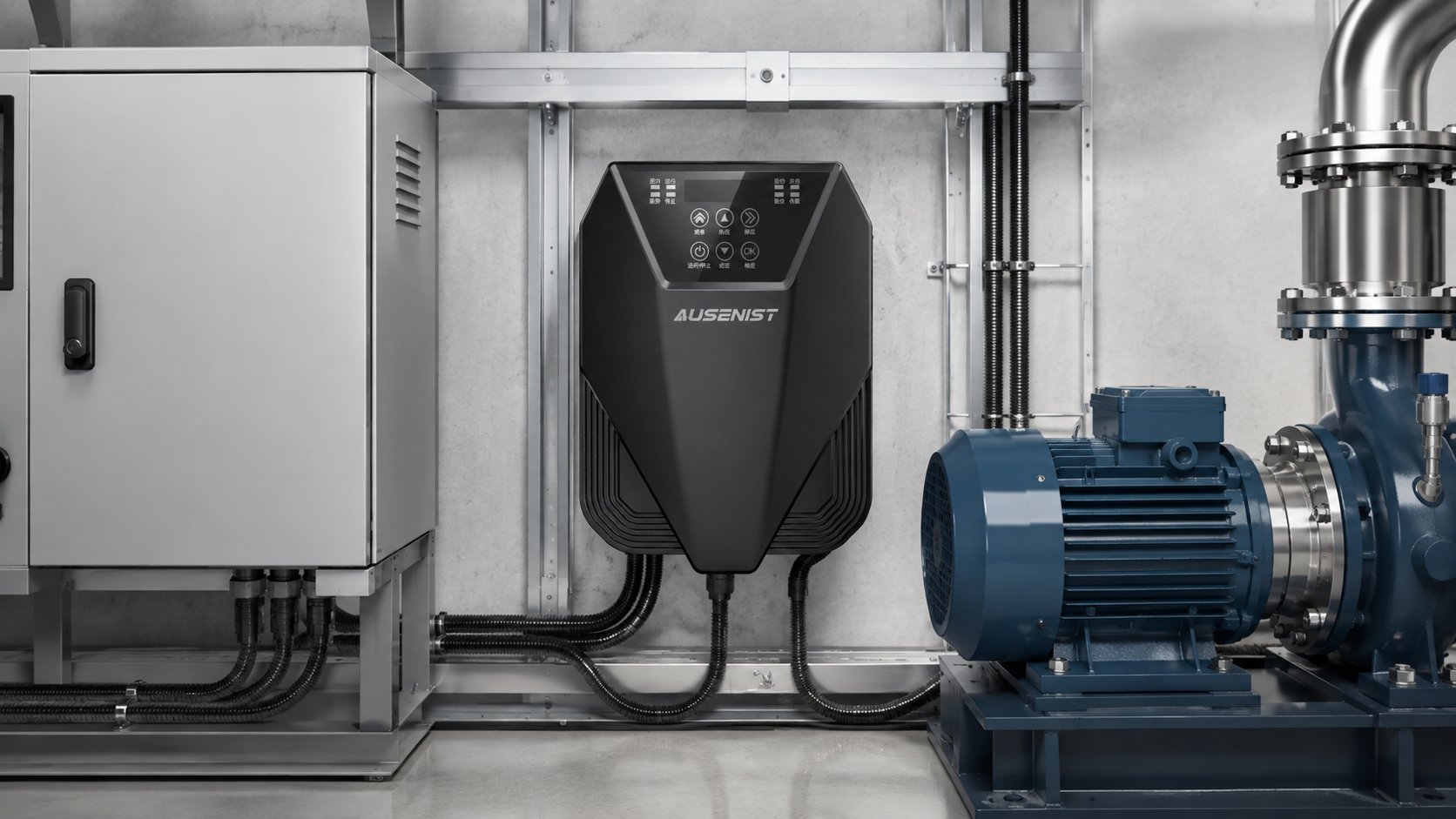
A 380 V three-phase water-pump motor can run from a 220 V single-phase supply only when the complete conversion solution is designed for that voltage step-up and the required motor current. An ordinary 220 V-class VFD normally provides a three-phase output in the same voltage class; it does not automatically provide full 380 V output. Use a purpose-built voltage-boost VFD or an engineered transformer-and-drive arrangement, and confirm the supply capacity before ordering.
What Information Is Required?
- Motor nameplate: 380 V rating, current, kW, frequency, speed, motor type and winding options.
- Available supply: measured voltage, single-phase frequency, breaker rating, cable size and source capacity.
- Pump application, operating hours, required flow and head, and whether full-speed output is necessary.
- Number of pumps and whether any other large load starts from the same supply.
- Control requirements: constant pressure, sensor signal, tank level, terminals or remote communication.
- Site temperature, altitude, enclosure, cable length and grounding arrangement.
Also check whether the motor is dual voltage. A nameplate marked 220/380 V may allow a winding reconnection that changes the most practical solution, but only a qualified person should interpret and change the terminals.
Selection Example
A site has 220 V single-phase power and a pump motor rated 4 kW, 380 V, 8.5 A, 50 Hz. The required output is approximately 380 V three phase at a current suitable for the 8.5 A motor. The input side will draw substantially more current than 8.5 A because it operates at lower voltage, uses single-phase power and includes conversion losses.
The supplier must confirm the proposed unit is explicitly rated for 220 V single-phase input and 380 V three-phase output at the required load. The electrician must verify the feeder, breaker, voltage drop and available source capacity from the manufacturer's input-current data. The pump is then commissioned with its actual pressure or flow duty, not merely run unloaded.
Common Mistakes
- Buying a standard 220 V input VFD and assuming a parameter can change its output to 380 V.
- Calculating the upstream circuit from the motor's 380 V current.
- Ignoring voltage drop on a weak rural or generator supply.
- Using a step-up device that is not suitable for a VFD's electrical behavior or load duty.
- Ordering before checking whether the motor can be reconnected for a 220 V-class output.
AUSENIST Solution
AUSENIST can evaluate special-voltage pump projects from the supply data, motor nameplate, current, pump duty and control requirements. Where a compatible YS620, YS820 or engineered special-voltage configuration is available, support can include model matching, basic parameters, pressure control and protection logic.
This conversion is not a universal catalog promise. It is unsuitable if the proposed drive lacks a confirmed boost topology, the single-phase source cannot supply the input current, the motor insulation or winding is incompatible, or the required rating falls outside verified limits. In those cases, a different motor, a three-phase supply or an engineered transformer solution may be safer and more economical.
Send us your motor nameplate. We can recommend the VFD model and basic parameter configuration.