 Quanzhou Ausenist Technology Co., Ltd
 220V Single Phase Input VFD for Water Pump: Selection Guide
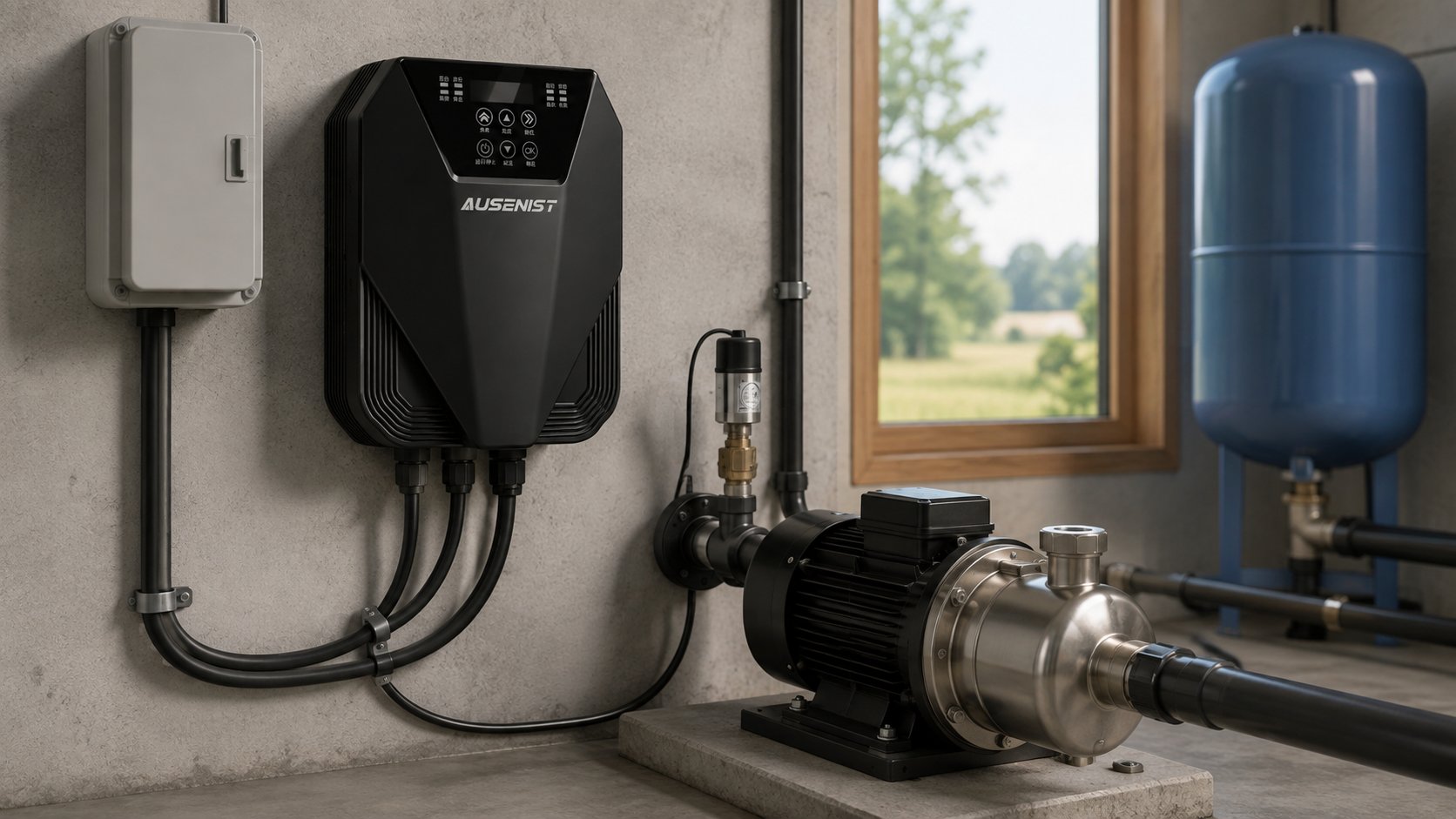
To select a 220V single-phase input VFD for a water pump, first confirm both the available supply and the motor nameplate. A common solution accepts approximately 220–240 V single-phase input and drives a compatible three-phase motor with an output voltage class around 220–240 V. It does not normally turn a standard 220 V input into 380 V output unless the product has a specifically designed voltage-boost function.
Motor rated current is usually more important than simply matching kW. The input circuit must also carry the higher single-phase current, and the final selection must follow the proposed VFD's documented ratings.
What Information Is Required?
- Motor nameplate showing voltage connection, rated current, power, frequency, speed and motor type.
- Available input voltage, phase, frequency, breaker capacity and expected voltage drop.
- Pump application, such as constant-pressure boosting, irrigation, deep well or circulation.
- Number of pumps and whether they start separately or operate together.
- Control requirement: keypad speed, pressure PID, tank level, terminals, RS485 or automatic restart.
- Cable length, ambient temperature, altitude, enclosure and mounting location.
For a dual-voltage motor, include the terminal connection diagram. A motor marked 220/380 V may use different winding connections for different line voltages; a qualified technician must confirm the correct connection.
Selection Example
Consider a centrifugal-pump motor rated 2.2 kW, 220 V three-phase and 10 A, while the site has 220 V single-phase power. The VFD must be a model specifically rated for single-phase input and compatible three-phase output. Its continuous output-current rating must cover at least the 10 A motor current under the actual ambient and altitude conditions.
The upstream breaker, cable and isolator must be selected for the VFD's documented single-phase input current, not the motor's three-phase current. If constant pressure is required, also confirm the pressure-sensor input, PID function, sleep and wake logic and minimum safe pump speed. The exact AUSENIST model can be chosen only after checking current product data.
Common Mistakes
- Assuming every three-phase-input VFD can be connected to single-phase power at full rating.
- Believing a normal 220 V-class VFD automatically produces 380 V output.
- Selecting only by 2.2 kW and ignoring the motor's 10 A nameplate current.
- Leaving a dual-voltage motor in the wrong winding connection.
- Sizing the breaker and input cable from motor current instead of VFD input data.
AUSENIST Solution
AUSENIST can review the input supply, motor nameplate, winding connection, pump duty and control requirement before recommending a YS620 or YS820 configuration. The review may include output-current matching, constant-pressure parameters, sensor selection, protection logic and OEM pump-package settings.
A 220 V single-phase input project is not suitable when the motor voltage cannot be produced by the proposed drive, the supply cannot support the required input current, or the motor and pump fall outside confirmed ratings. A 380 V motor may need a purpose-built voltage-boost VFD, a transformer-based solution, motor reconnection or motor replacement; engineering confirmation is required before purchase.
Send us your motor nameplate. We can recommend the VFD model and basic parameter configuration.