 Quanzhou Ausenist Technology Co., Ltd
 Best Water Pump VFD Manufacturer in China: What Buyers Should Check
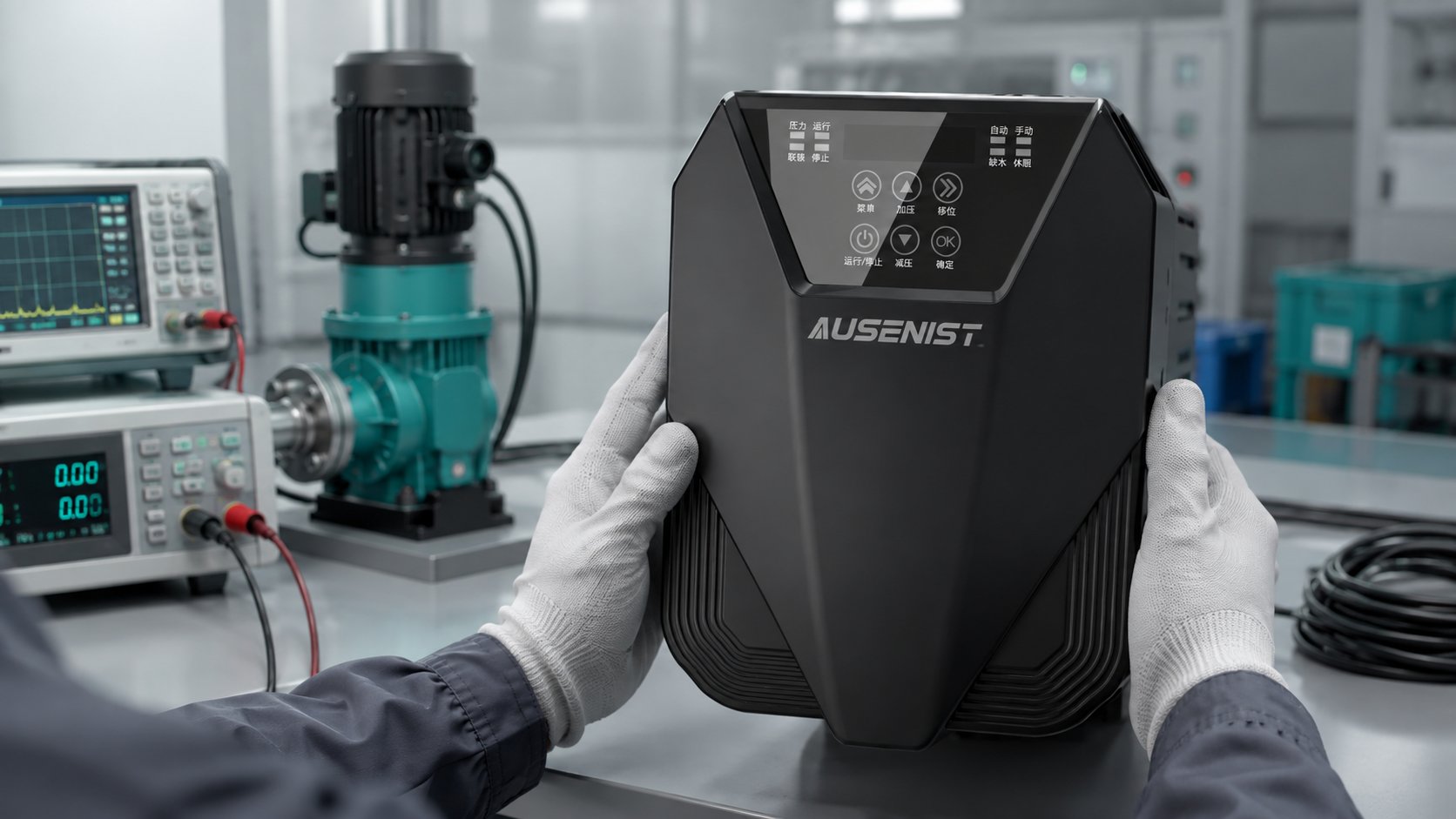
The best water pump VFD manufacturer is not simply the factory with the lowest price, the largest power range or the strongest advertising. Buyers should compare whether the supplier can match the drive to the motor current, power supply, pump curve, pressure or flow target, control sequence and installation environment. A suitable supplier should also explain its limits instead of approving every application without technical review.
What Information Is Required?
Prepare the following information before comparing manufacturers:
- A clear motor nameplate showing rated voltage, rated current, power, frequency, speed and motor type.
- The available input power, including voltage, phase, frequency and expected voltage variation.
- The pump application, such as constant-pressure boosting, irrigation, deep-well pumping, circulation or sewage service.
- The number of pumps and whether they operate independently, in lead-lag sequence or with standby rotation.
- The required control method: manual speed, pressure PID, flow, tank level, RS485 or an external controller.
- The installation environment, enclosure requirement, ambient temperature, altitude and motor-cable length.
- Required documents, labels, packaging, communication settings and local compliance evidence.
A supplier that asks for only motor kW is not evaluating the complete duty. Motor current often determines the minimum drive output rating, while the hydraulic system determines whether variable-speed operation will work safely.
Selection Example
Consider a 4 kW, 380 V, 8.5 A centrifugal pump used for constant-pressure water supply. The factory should first verify that the selected VFD has a continuous output-current rating suitable for at least the motor nameplate current under the actual ambient temperature and altitude. It should then check the pressure-transmitter signal, target pressure, pump count, sleep and wake behavior, minimum safe speed, cable length and protection logic.
The recommendation should not be “choose any 4 kW VFD.” Two drives with the same nominal kW can have different current ratings, pump-control functions, environmental limits and commissioning requirements. The final model must be confirmed from current product documentation and project data.
What Buyers Should Compare
Pump Application Knowledge
Ask the supplier to explain how it would select and commission a drive for one of your real pumps. A useful answer connects electrical limits with pressure, flow, minimum speed, dry-run risk and operating sequence.
Product and Parameter Control
Request the exact manual, rating table, wiring diagram and parameter list for the proposed model. For repeat orders, ask how approved parameter files and firmware or hardware revisions are controlled.
Test Evidence
Clarify what is tested on a sample and in production. Power-up alone is insufficient for an OEM pump package. Representative testing may need to cover motor control, feedback signals, sleep and wake, alarms, communication and pump sequencing.
Support and Customization Boundaries
Ask who reviews special voltage, PMSM, multi-pump, enclosure, communication and branding requests. A credible manufacturer separates standard configuration, engineering customization and unsupported requests.
Common Mistakes
- Ranking factories only by unit price without comparing technical scope.
- Matching VFD and motor by kW while ignoring rated motor current.
- Assuming every “pump VFD” supports the required sensor or multi-pump logic.
- Treating a customized label as proof of a technically customized product.
- Accepting undocumented claims about certifications, energy savings or environmental ratings.
AUSENIST Solution
AUSENIST focuses on matching YS620 and YS820 solutions to water-pump applications. The review can include motor and supply matching, constant-pressure control, multi-pump requirements, PMSM or induction-motor compatibility, special-voltage feasibility, pump-mounted integration, parameter preparation and OEM branding.
The correct proposal depends on the actual motor, pump and control data. AUSENIST may not be the right supplier when the application falls outside confirmed product ratings, requires an unverified local approval, or is a heavy-duty non-pump duty that has not been technically evaluated. Stating that boundary protects both the buyer and the final installation.
Send us your motor nameplate. We can recommend the VFD model and basic parameter configuration.